
Get Healthy!
- Posted March 26, 2026
Bees and Hummingbirds May Be Consuming Small Amounts of Alcohol
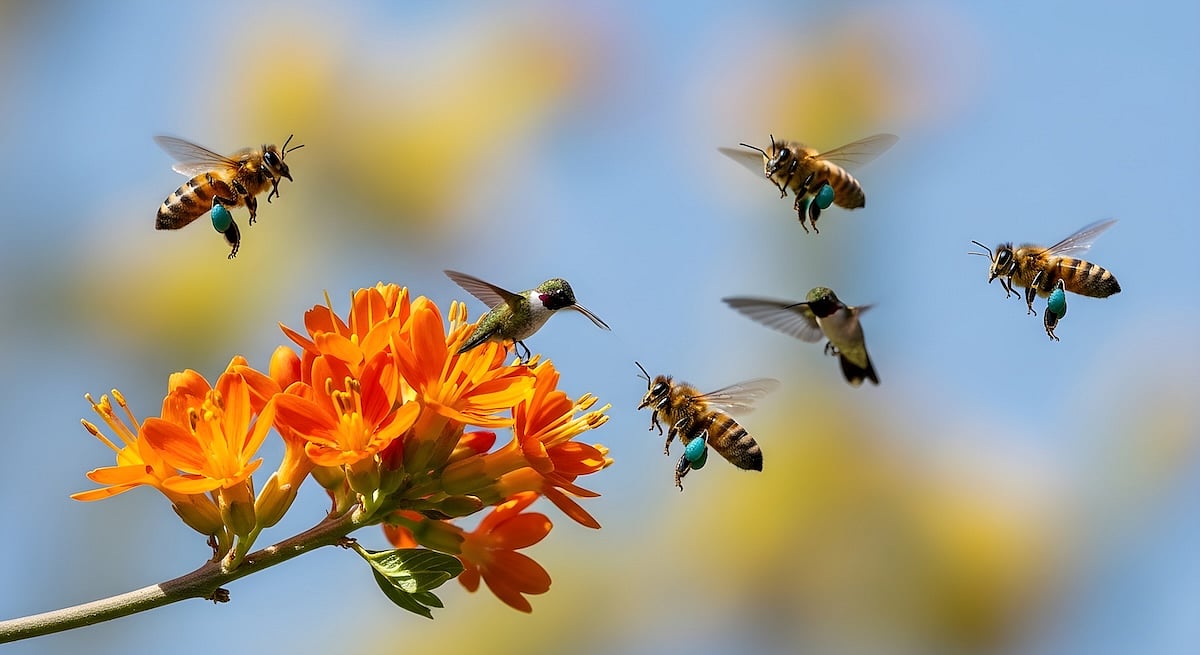
Bees getting buzzed? It may sound like a joke, but when bees and hummingbirds visit flowers, they're often consuming small amounts of alcohol alongside the yummy nectar.
A new study from the University of California, Berkeley, found that many flowers have small amounts of alcohol in their nectar.
Researchers tested nectar from 29 plant species and found ethanol, a type of alcohol, in 26 of them.
Most samples only had tiny amounts. But one sample reached 0.056% ethanol by weight, which is about 0.1 proof.
The research was published March 25 in the journal Royal Science Open Science.
The scientists said the alcohol likely forms when yeast ferments sugar in the nectar.
Even though the amounts are small, nectar is the main food source for many species, researchers explained.
Hummingbirds, for example, drink large amounts a day (often 50% to 150% of their body weight).
Based on that, researchers estimated that an Anna’s hummingbird, for example, consumes about 0.2 grams of ethanol per kilogram of body weight daily. That’s similar to what a human would get from about one alcoholic drink a day.
But bees and birds don't seem to get drunk. Instead, researchers said, they consume nectar slowly throughout the day, and their bodies process it fairly fast.
"Hummingbirds are like little furnaces. They burn through everything really quick, so you don't expect anything to accumulate in their bloodstream," Aleksey Maro, a doctoral student at UC Berkeley who worked on the study, said in a news release.
Scientists said that the alcohol in nectar could still affect animal behavior in subtle ways.
Other compounds in nectar, such as caffeine and nicotine, are already known to influence animal behavior.
"But we don't know what kind of signaling or appetitive properties the alcohol has," Maro explained. "There are other things that the ethanol could be doing aside from creating a buzz, like with humans."
Robert Dudley, a biology professor at UC Berkeley, agreed.
"They're burning it so fast, I'm guessing that they probably aren't suffering inebriating effects," he said. "But it may also have other consequences for their behavior."
In earlier experiments, researchers offered hummingbirds sugar water. The birds were fine with low levels below 1% alcohol, but tended to avoid stronger mixtures.
When alcohol was at 2%, they visited the feeders only about half as often.
"Somehow they are metering their intake, so maybe zero to 1% is a more likely concentration that they would find in the wild than anything higher," Dudley said.
Researchers in another study detected a byproduct of alcohol in hummingbird feathers.
They suspect that animals may have developed a tolerance to small amounts of alcohol over time.
"The laboratory experiment was showing that yes, they will drink ethanol in their nectar, though they have some aversion to it if it gets too high," said Ammon Corl, who also worked on the study. "The feathers are saying that, yes, they will metabolize it. And then this study is saying that ethanol is actually pretty widespread in the nectar they consume."
The team also compared alcohol intake across other species:
Tree shrews had the highest intake at 1.4 grams/kg/day.
European honeybees had the lowest at 0.05 g/kg/day.
Nectar-feeding birds fell in between, at about 0.19 to 0.27 g/kg/day.
In some cases, hummingbirds may actually get more alcohol from sugar water feeders than from natural flowers.
"These studies suggest that there may be a broad range of physiological adaptations across the animal kingdom to the ubiquity of dietary ethanol, and that the responses we see in humans may not be representative of all primates or of all animals generally," Dudley said.
More information
Britannica has more on nectar.
SOURCE: University of California, Berkeley, news release, March 25, 2026


